
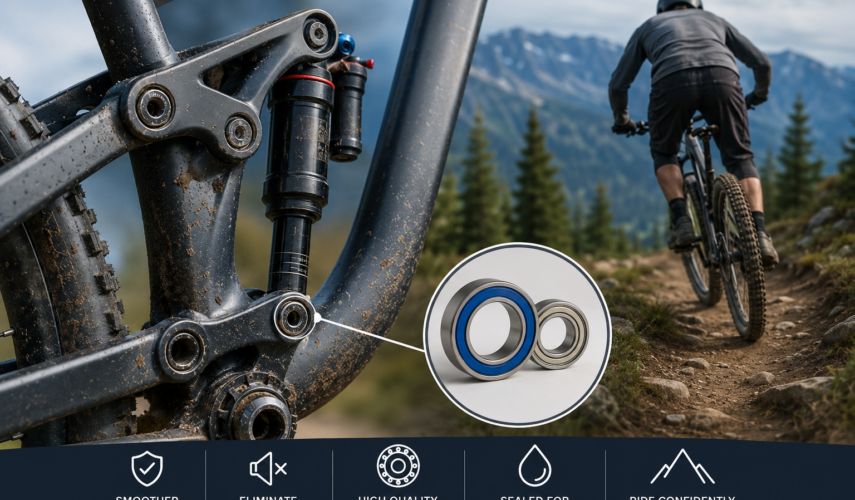

If your rear suspension has started to feel vague, gritty, or a bit loose when you push down on the saddle, there’s a good chance it isn’t your shock — it’s your mountain bike pivot bearings. These small, sealed bearings sit at every point where your frame’s suspension linkage rotates, and on a full-suspension bike there can be anywhere from four to a dozen of them working every time your rear wheel moves. They take a battering ride after ride, and unlike a headset or bottom bracket, worn pivot bearings are often missed until the damage spreads to the frame itself.
Here’s how to tell when yours need attention, and what to do about it.
What Do Pivot Bearings Actually Do?
Every full-suspension frame relies on a linkage system to let the rear triangle move independently of the front. Wherever two parts of that linkage meet — the main pivot, the rocker link, the seat stay, the shock mounts — you’ll typically find a sealed cartridge bearing, often available in standard or Max Complement designs depending on the frame and application. They’re small, but they’re doing a genuinely hard job: constant micro-movement, exposure to mud and water, and load from every bump the bike absorbs.
7 Signs Your Pivot Bearings Are Worn
1. Play you can feel by hand. With the shock removed or unclipped, grab the rear wheel and rock it sides to side. Any knock, click, or looseness in the linkage — separate from headset or hub play — usually points to worn pivot bearings.
2. A clunk or knock over small bumps. Rather than the smooth, controlled feel of healthy suspension, worn bearings often produce a distinct knock-on square-edge hits or when you unweight the bike.
3. Notchy or gritty movement. Compress the rear suspension by hand with the shock disconnected. It should move freely through its travel. Grittiness or resistance at certain points is a sign the bearing’s internals have worn or lost their seal.
4. Suspension that feels vague or wallowy. Bearings with excess play let the linkage move slightly off-axis, which can make well-set-up suspension suddenly feel imprecise or inconsistent.
5. Visible corrosion or a damaged seal. If you strip the linkage down, check the bearing seals for cracking, rust bleeding out of the edges, or missing grease. Once the seal fails, water and grit get in fast.
6. Squeaking or creaking on the trail. Not every creak is a pivot bearing — check your dropper post, bottle cage bolts, and cranks first — but a creak that changes with rear suspension movement is a strong clue.
7. It’s simply been a while. Even without obvious symptoms, pivot bearings on a bike ridden regularly in UK weather are generally worth inspecting every 6–12 months, and sooner if you ride a lot of wet, muddy trail.
Why Ignoring Worn Pivot Bearings Gets Expensive
A worn bearing doesn’t just affect feel — it changes how load passes through the linkage. Left too long, that play can start to wear the aluminium or carbon bore the bearing sits in, turning a straightforward bearing swap into a much costlier frame repair or replacement. Catching it early is by far the cheaper option.
How to Check Your Pivot Bearings at Home
You don’t need a workshop to do a basic check:
- Remove the rear shock (or disconnect one end) so the linkage moves freely without spring resistance.
- Cycle the rear suspension through its full travel by hand, feeling for grittiness or tight spots.
- With the shock out, grab the rear wheel and try to rock it side to side and front to back, isolating movement in the linkage from any play in the hub or headset.
- Visually inspect each pivot point for water staining, rust streaks, or a bearing that’s visibly sitting proud or loose in its bore.
If you feel play, grittiness, or hear a knock that lines up with a specific pivot, that bearing is due for replacement.
Replacing Pivot Bearings: What You Need to Know
Frame bearings are pressed into the frame, so replacement means removing the old bearing (a bearing press or a well-supported socket set works for most home mechanics) and pressing in the correct replacement, matched exactly to your frame’s dimensions — getting this wrong is the most common mistake, since even bearings that look similar can differ by a fraction of a millimetre in bore or width.
That’s why we sell frame bearing kits matched to specific bike models rather than generic sizes — every bearing in the kit is the correct spec for your exact frame, in either standard steel or our SLB and Enduro Max Complement options for riders who want longer-lasting seals in wet conditions.
Browse our Frame Bearing Kits by brand to find the right kit for your bike or get in touch if you’re not sure which bearings your frame uses — we’re happy to help you match them before you order.
FAQs
How often should I replace mountain bike pivot bearings? There’s no fixed mileage, but a yearly check is sensible for regular riders, and more frequent inspection if you ride a lot in wet or muddy conditions, since water ingress is the main cause of early failure.
Can I grease pivot bearings instead of replacing them? Sealed cartridge bearings aren’t designed to be re-greased once the seal has failed — by that point water and grit have usually already caused pitting inside the bearing, so replacement is the reliable fix.
Do all full-suspension bikes use the same pivot bearings? No. Bearing size and type vary by frame model and even by model year, which is why matching the correct kit to your specific bike matters.
Is it worse to have a squeaky bearing or a loose one? Play (looseness) generally indicates more advanced wear and a higher risk of it damaging the frame bore, so address noticeable play sooner rather than later.