
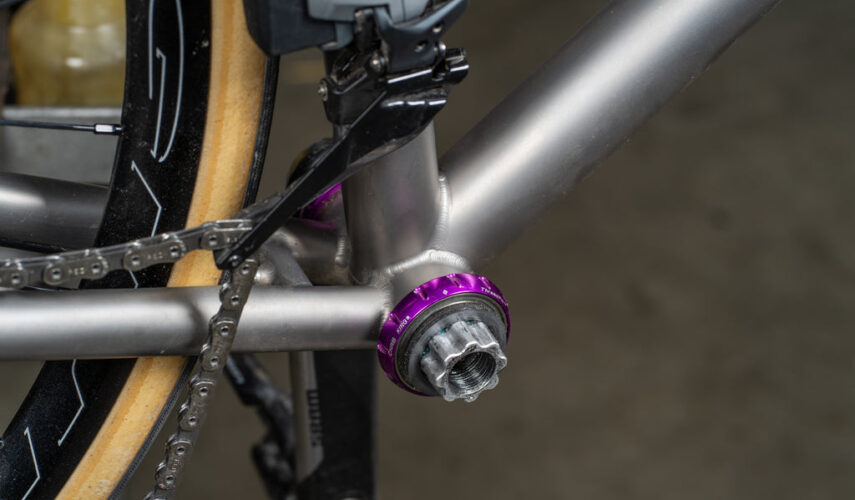

If your bike has started creaking when you put the power down, or your pedalling feels rougher than it used to, there is a good chance your bottom bracket bearing is on the way out. It is one of those components that quietly does its job until it cannot — and when it goes, it takes your efficiency (and your nerves) with it.
The good news is that replacing a bottom bracket bearing is straightforward — as long as you order the right one. Get the wrong type or size and it simply will not fit. This guide walks you through everything you need to know: what the BB bearing actually does, the different BB standards and how to identify yours, which material suits your riding, and how to find the exact size. By the end, you will know precisely which bearing to order.
What does a bottom bracket bearing actually do?
The bottom bracket sits inside the shell at the very bottom of your frame — the wide tube that connects the seat tube, down tube, and chain stays. Inside that shell is the bottom bracket bearing, and its job is to let your crankset spin freely while supporting everything you throw at it.
Every pedal stroke loads the bearing in two ways: radially (the downward force of your body weight through the cranks) and axially (the side-to-side force as you pedal out of the saddle or corner hard). A worn or incorrectly specified bearing struggles with these combined loads, and that is when you start hearing that familiar creak.
Bottom bracket types: threaded, press fit, and BB30
This is the most important section of the guide. Most people who order the wrong bearing do so because they did not know their BB standard — not because they chose the wrong material or size. There are six main standards in common use, and they are not interchangeable.
| BB standard | Shell diameter | Shell width | Bearing type |
| BSA / English threaded | 34.8mm | 68mm or 73mm | Cartridge sealed |
| Italian threaded | 36mm | 70mm | Cartridge sealed |
| BB30 | 42mm | 68mm or 73mm | Direct-fit angular |
| PF30 (press fit) | 46mm | 68mm or 73mm | Press-fit cartridge |
| BB86 / BB92 (press fit) | 41mm | 86mm or 92mm | Press-fit cartridge |
| T47 threaded | 47mm | 68mm or 100mm | Cartridge sealed |
How to identify your BB standard
You do not need to be a mechanic to work this out. Here is a simple three-step check:
- Look at the BB shell on your frame — is it threaded (you can see threads inside the shell) or smooth? Smooth means press fit.
- Measure the shell width with a tape measure or ruler. The most common threaded width is 68mm on road bikes and 73mm on mountain bikes. If it measures 86mm or 92mm, you have a press fit BB86 or BB92 frame.
- Check your crank set. The spindle diameter tells you which bearing inner diameter you need. Most modern Shimano cranks are 24mm; SRAM GXP is 24mm/22mm stepped; BB30 cranks are 30mm.
If you are still unsure, the easiest shortcut is to check your bike’s original spec sheet or the frame manufacturer’s website. Alternatively, bring your bike’s make, model, and year to our team — we will identify the standard and match the bearing for you.
Bottom bracket bearing materials: steel, stainless, and ceramic
Once you know your BB standard, the next choice is material. Aire Velo stocks BB bearings in four main material options, each suited to a different type of rider.
| Material | Best for | Why |
| Steel | Budget builds, casual riders, commuters | Reliable, affordable, easy to source in all sizes |
| Stainless steel | Year-round riders, wet UK conditions, touring | Corrosion-resistant — handles mud, rain, and winter salt |
| Hybrid ceramic | Performance road cyclists, enthusiast MTB riders | Lower friction than steel, longer service life, faster spin |
| Full ceramic | Racing, time trials, weight-weenies | Lightest, lowest rolling resistance — but premium price |
For most UK cyclists riding year-round in mixed weather, stainless steel is the practical sweet spot — it handles the wet without corroding, lasts longer than standard steel, and costs a fraction of ceramic. Save ceramic for a dedicated performance bike or race season build.
Choosing a BB bearing by bike type
Road bike
Road cyclists prioritise low rolling resistance — you are looking for every marginal gain, and a smooth-spinning BB contributes to that. Hybrid ceramic is the go-to for most performance road riders: Si₃N₄ ceramic balls in steel races give you a noticeably freer spin without the full-ceramic price tag. For wet-weather road riders, a stainless-steel sealed bearing is the sensible choice.
Mountain bike and trail
MTB bearings take a beating from mud, water, and the constant impact of technical terrain. Durability and contamination resistance matter more than outright rolling efficiency here. Sealed stainless steel bearings are the workhorse choice for most trail riders. If you are doing high-mileage enduro riding in particularly wet conditions, black oxide-treated stainless bearings offer an extra layer of corrosion resistance.
Commuter and hybrid bike
Commuter bikes need low-maintenance reliability above all else. A sealed steel or stainless-steel bearing will outlast most drivetrain components if it is the right size and properly installed. There is no benefit to spending more on ceramic for a commuter — save the money for a new chain.
How to find the right bearing size
Every bearing is defined by three numbers: inner diameter (ID), outer diameter (OD), and width. These are usually printed on the bearing’s outer race — look for a number like 6805, 6806, or 61802. Here is how to read it:
- 6805: ID = 25mm, OD = 37mm, width = 7mm. Common in road BB30 and Shimano Hollow tech crank sets.
- 6806: ID = 30mm, OD = 42mm, width = 7mm. Common in BB30 direct-fit frames.
- 6902: ID = 15mm, OD = 28mm, width = 7mm. Common in Italian threaded BB shells.
If you are replacing a bearing like-for-like, the easiest approach is to remove the existing bearing and read the number stamped on it. If the number has worn off or you cannot identify it, measure the three dimensions with a calliper and cross-reference against a bearing size chart.
Not sure of your size? Our team can match a bearing to your exact bike model — just get in touch with your bike’s make, model, and crankset and we will do the rest.
Signs your bottom bracket bearing needs replacing
Catching a worn BB early prevents damage to the BB shell threads or your crankset spindle — both of which are expensive to fix. Watch out for these signs:
- Creaking or clicking when pedalling, especially under load or out of the saddle
- Rough, grinding, or notchy feel when you spin the cranks by hand
- Visible lateral play — grab the crank arm and push it side to side; any movement means the bearing is worn
- Corrosion or pitting visible on the bearing if you remove the crankset
The quick home check: unship your chain, hold the frame, and spin the cranks slowly by hand. Smooth and silent means the bearing is still good. Any resistance, roughness, or noise and it is time to replace it.
Our bottom bracket bearing range
Aire Velo stocks BB bearings in steel, stainless steel, hybrid ceramic, and full ceramic — available across all common BB standards including BSA threaded, press fit (PF30, BB86, BB92), BB30, and T47. We stock bearings from NSK and NTN, two of Japan’s most trusted bearing manufacturers, as well as our own-range options.
Whether you need a straightforward like-for-like replacement or are upgrading to ceramic for a performance road build, we have the right bearing in stock and ready to dispatch. Our team — three of whom are keen cyclists — are always on hand if you are unsure what you need. Not sure which to order? Drop us a message with your bike model and crankset and we will point you straight to the right bearing.
Ready to replace your bottom bracket bearing?
Browse our full range of bottom bracket bearings — steel, stainless, and ceramic across all BB standards, with same-day dispatch on orders placed before 4pm. Or send us your bike model and we will match the right bearing for you.
Shop bottom bracket bearings at Aire Velo Bearings: airevelobearings.com/product-category/bottom-bracket-bearing-kits
Questions? Call us: 0113 256 5676 | Email: [email protected]
Frequently asked questions
What size bottom bracket bearing do I need?
The size depends on your BB standard and crankset spindle diameter. Remove your existing bearing and read the number stamped on the outer race (e.g. 6805, 6806). If the number has worn off, measure the inner diameter, outer diameter, and width with a calliper and use those three numbers to find the matching bearing.
How long do bottom bracket bearings last?
A well-maintained sealed steel BB bearing typically lasts 3,000 to 5,000 miles under normal riding conditions. Ceramic bearings can last significantly longer. Riding in wet or muddy conditions, or neglecting creaks when they first appear, will shorten the service life considerably.
Are ceramic bottom bracket bearings worth it?
For performance road cyclists and racers, yes — hybrid ceramic bearings offer measurably lower rolling resistance and a longer service life than steel. For commuters and recreational riders, the cost premium is harder to justify. Stainless steel delivers excellent longevity at a fraction of the price.
What is the difference between threaded and press fit bottom brackets?
A threaded BB shell has internal threads — the BB cups screw in and out. A press fit shell is smooth; the bearing cups are pressed directly into the frame. Threaded (especially BSA/English) is generally easier to service and less prone to creaking. Press fit is lighter and allows larger shell diameters but requires the correct installation tools.
Can I replace my bottom bracket bearing myself?
Yes, with the right tools. Threaded BB standards require a BB spanner and a crank extractor. Press fit standards need a dedicated press and puller — attempting to use a hammer risk damaging the frame. If you are not confident, most bike shops will fit a supplied bearing for a small labour charge.